Tuesday, February 8, 2022

shyamala.

 Kalidasa was one of the great Sanskrit poets. He wrote many great dramas like Shakunthalam and great epics like Kumara Sambhavam, Malavikagni mithram, the message poetry called Megha Sandesham etc. He is extremely famous for the use of appropriate similes and metaphors. Shyamala Dandakam is perhaps the greatest stotra written by him eulogizing the mother goddess Shyamala.

He has employed a poetic style called Dandakam in writing this prayer. Dandakam is that poetry where some of the lines have more than 26 syllables. It very much resembles prose. In this case, the entire Dandakam is a single sentence from start to the end. I have attempted to retain the same style

There is a folk story about how he came about to write this stotra. He was a foolish wood cutter who was made to act wise by the courtiers of a proud princess and thus convinced the princess marry him. The princess advised the wood cutter to enter in to a temple of Kali, and when she went for a walk, he locked himself in. When Kali came back, the wood cutter refused to allow her in, unless she made him wise. After she did, the first prayer of this wood cutter to Kali was Shyamala Dandakam.

One entry giving full sloka is already there earlier. 

N E I

 .


               *NORTH EAST INDIA* 


          Arunachal  Pradesh Governor *P B Acharya* said, "Indians know more about the US than about  the Northeast".


          He made a valid point - very few of us know enough about the Northeast.


          Here are some of the surprising facts about the Northeast.


          1.     There are *eight states* in Northeast: Arunachal Pradesh, Mizoram, Assam, Manipur, Meghalaya, Tripura, Sikkim, Nagaland.


          2.     There are nearly *220 languages* spoken in the Northeast, It is a mix of Tibetan, South-east Asian and East Indian Cultures.


          3.     Northeast is the only part of India that the *Mughal Empire could not  conquer*.


          4.     The *Ahom Dynasty*, which ruled the Northeast for 600 years, is the longest unbroken Dynasty in Indian history.


          5.     The world's largest river island, the *Majuli* and the world's smallest river island, *Umananda* both are in the Northeast.


          6.     *Seven prominent National Parks* of India are located in Northeast.


          7.     *Shillong* is considered as the Rock Capital of India.


          8.     *Mawsynram* in Meghalaya holds the Guinness World Record for being the Wettest Place on Earth.


          9.     *Sualkuchi* in Assam is one of the World's largest weaving villages where the entire population is engaged in weaving Silk Fabrics.


          10.    *Muga*, the Golden Silk of Assam, is not produced anywhere else in the World.


          11.    It is the cleanest region in India. *Mawlynnong* in Meghalaya is the cleanest village in *entire Asia*.


          12.    70% of the country's *Orchids* are found in Northeast.


          13.    Mizoram and Tripura are among the states with the highest *Literacy* rate in India.


          14.    There is *no Dowry* culture in entire Northeast.


          15.    Sikkim is the first state in the world where 100% of its agro produce is organic and certified so. Sikkim won the Future Policy Award 2018, beating 51 nominated policies from 25 countries, according to a statement. Policies from Brazil, Denmark and Quito (Ecuador) bagged silver awards.


          The award is co-organised by the Food and Agriculture Organisation of the United Nations (FAO), the World Future Council (WFC) and IFOAM – Organics International


          Kindly spread this information to all your contacts to help develop awareness of the Northeast part of India further.

Pro

 https://youtu.be/QV4LtARrM_A

Monday, February 7, 2022

Moha Mudgara

Moha Mudgara (Destroyer of illusion) is a popular Hindu devotional poem in Sanskrit composed by Adi Shankara. This work of Adi Shankara underscores the view that Bhakti (devotion) is also important part along with Jnana (knowledge), as emphasised by the bhakti movement. A popular rendition sung by M. S. Subbulakshmi begins with the shloka । स्थापकाय च धर्मस्य सर्वधर्म-स्वरूपिणे ।। अवतार-वरिष्ठाय रामकृष्णाय ते नमः ॥ meaning "(Salutations) to the establisher of Dharma who is of the essence of all of nature; salutations to that great incarnation of the form of Ramakrishna."

 There is a story related to the composition of this Hymn. It is said that Shri Adi Shankaracharya, accompanied by his disciples, was walking along a street in Varanasi one day when he came across an old aged scholar reciting the rules of Sanskrit grammar of Panini repeatedly on the street. Taking pity on him, Adi Shankara went up to the scholar and advised him not to waste his time on grammar at his age but to turn his mind to God in worship and adoration, which would only save him from this vicious cycle of life and death. The hymn "Bhaja Govindam" is said to have been composed on this occasion.

This composition is a reminder that Adi Shankaracharya, who is often regarded as reviver of Hinduism Jnana Marga  or the "Path of Knowledge" to attain Mukti also was a proponent of Bhakti Marga (Bhakti Yoga) to attain the same goal, and as C Rajagopalachari put in his commentary, "When intelligence (jnana) matures and lodges securely in the heart, it becomes wisdom (vignyana). When that wisdom (vignyana) is integrated with life and issues out in action, it becomes devotion (bhakti). Knowledge (jnana) which has become mature is spoken of as devotion (bhakti). If it does not get transformed into devotion (bhakti), such knowledge (jnana) is useless tinsel."

In this prayer, Adi Shankaracharya emphasizes the importance of devotion for God as a means to spiritual development and to liberation from the cycle of birth and death. The prayer leaves one in no doubt that the renunciation of our egotistical differences and surrender to God makes for salvation. Many scholars hold that this composition encapsulates with both brevity and simplicity the substance of all Veantic thought found in whatever other works that Adi Shankaracharya wrote:

The refrain "Bhaja Govindam" which defines the composition and gives it its name invokes the almighty in the aspect of supreme god Shree Krishna; it is therefore very popular not only with Sri Adi Shankaracharya's immediate followers, the Smarthas, but also with Vaishnavas and others.


Govinda (also known as Govind and Gobind) are the names of Vishnu. The name appears as the 187th and the 539th name of Lord Vishnu in Vishnu Sahasranama. Lord Vishnu or his complete incarnation Krishna are regarded as the Supreme God in the Vaishnava tradition and also by much of the pan-Hindu tradition. The name is also popularly addressed to Krishna, referring to his youthful activity as a cowheard boy.


Govinda has four meanings

  1. The sages call Krishna "Govinda" as He pervades all the worlds, giving them power.
  2. The Shanti Parva of the Mahabaratha states that Vishnu restored the earth that had sunk into the netherworld, or naraga in Tamil, so all the devas praised Him as Govind (Protector of the Land).
  3. Alternatively, it means "He who is known by Vedic words alone".
  4. In the Harivamsha, Indra praised Krishna for having attained loving leadership of the cows which Krishna tended as a cowherd, by saying, "So men too shall praise Him as Govinda."

Maharishi Mahesh Yogi, in his commentary on the Bhagavad-Gita, states that Govinda means "master of the senses". In the Mahabharata, when Draupadi's saree was stripped by Dhushasana in the court of Hastinapura, it is said that Draupadi prayed towards Lord Krishna (who was in Dwaraka at that time) invoking him as "Govinda" at the instance of extreme distress where she could no longer hold her saree to her chest. For this reason, it is believed that "Govinda" is how the Lord is addressed by devotees when they have lost it all and have nothing more to lose. This may be the reason why in colloquial Tamil and Telugu the slang-term "govinda" sometimes refers to the prospect of losing or failing in something important.


Sunday, February 6, 2022

A proud moment.

 https://www.facebook.com/100026470822213/posts/979933756232309/


Very proud that our guru got such a tremendous tribute at Hyderabad.  Hyderabad us such a cosmopolitan city it's people are unique. And rightfully too they were able to bring about this unique glory to this city for which it will be known the world over for generations to come. 

Many people are of varied opinions but the fact that  this was accomplished is initself proof of the great idea and thought behind this dream. May the tribe grow. May the glory of the Saint reach the heights it was meant to be May every house top ring with the deeds and praises for this all great acharya bhagwan in human form.

My heart feels a sort of cool that this has come about and I am  a witness to this. For people who worry that his secret is out and it may be misused by some need to be assured that works and deeds of such great people is itself enough to protect it. 

Getting the film industry of telugu people to work for the great saints propaganda is the right  way  forward. 👍 

Saturday, February 5, 2022

Eqality tribute.

 https://www.facebook.com/100026470822213/posts/979477462944605/


Watch for full display of lighting and delivery of the great acharya by China jeyar swamy. A rightful tribute. We are blessed to belong to this day.  And time. 

Wednesday, February 2, 2022

ASRD

 thiruvAimozhi has 5 different vyAkyAnams (commentaries).

padi is a type of measurement – usually one padi means 32 aksharams (letters).

There are also several arumpadha viLakkams (detailed analysis of vyAkyAnams) which 

Of these nampiLLai‘s Idu mahA vyAkyAnam is the most comprehensive and detailed vyAkyAnam for thiruvAimozhi. nampiLLai being an expert in both samskrutham and thamizh literature, presents the views of our pUrvAchAryas in relation to sruthi, smruthi, ithihAsams/purANams, etc., in the most relishable and authoritative way.
Out of bhagavAn’s divine will, nampiLLai instructs Idu mahA vyAkyAnam to be kept confidential and highlights that in the future, emperumAn himself will reveal the same to everyone through the most apt AchArya. The history of Idu being transmitted from nampiLLai to mAmunigaL can be viewed at http://guruparamparai.wordpress.com/2013/04/21/eeynni-madhava-perumal/.


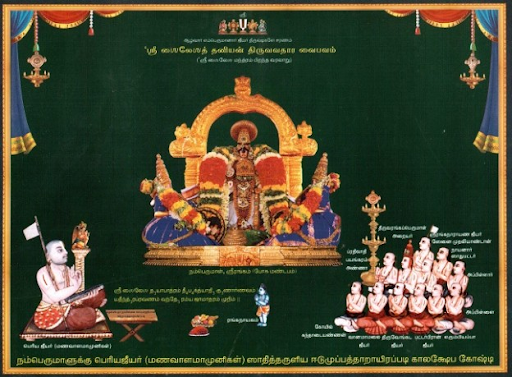
Mamunigal            learns the Idu mahA vyAkyAnam (and all other vyAkyAnams) through thiruvAimozhi piLLai and becomes fully attached to them. Though he was a great scholar in ubhaya vEdhAntham (samskrutham and thamizh vEdhAntham) – he fully spent his energy in rejuvenating dhivya prabandham and the various vyAkyAnams. He becomes such an expert in Idu mahA vyAkyAnam that he was famously known as “eettup perukkar” (the one who explains the divine meanings of Idu vyAkyAnam in the most detailed and precise manner). SrI ranganAthan, desirous of hearing the Idu vyAkyAnam through mAmunigaL, orders mAmunigaL to lecture the divine meanings of thiruvAimozhi with its vyAkyAnams for a whole year, right in front of his main sanctum in periya kOyil (SrIrangam). mAmunigaL accepts the orders of emperumAn and delivers his lectures with great enthusiasm. He lectures the Idu vyAkyAnam mainly and explains the principles in relation to sruthi, smruthi, ithihAsams/purANams, pAnchArAthram, other vyAkyAnams of thiruvAimozhi and other dhivya prabhandhams etc. On the most auspicious Ani thirumUlam day, he performs sARRumuRai (completion) of his kAlakshEpam. periya perumAL himself appears as a small boy and submits “SrISailESa dhayApAthram” thaniyan (a verse of glorification) to mAmunigaL and accepts him as his own AchArya. From then onwards, the glories of bhagavath vishaya (Idu) kAlakshEpam become well established and the same have been carried out by our sath sampradhAya AchAryas regularly.

Thus, we have seen the glories of thiruvAimozhi, Idu mahA vyAkyAnam and mAmunigaLemperumAn has great love for all 3 of them and thus he himself heard the thiruvAimozhi vyAkyAnam through mAmunigaL in periya kOyil (SrIrangam).

It is also common practice to explain thiruppallANdu and kaNNinuN chiRuth thAmbu vyAkyAnams before explaining thiruvAimozhi.

  • mAmunigaL highlights in upadhEsa raththina mAlai that “vEdhaththukku Om ennumathu pOl” – just like praNavam (OmkAra) is the essence of vEdham and is thus recited at the beginning of any vEdha pArAyaNam, thiruppallANdu highlights the identity of jIvAthmA and paramAthmA. So, thriuppallANdu is explained first to understand the sambandha gyAnam (knowledge about the relationship between jIvAthmA and paramAthmA).
  • mAmunigaL highlights in upadhEsa raththina mAlai that “vAyththa thirumanthiraththin maththimamAm padham pOl” – just like the “nama:” which explains the upAyam and is in the middle of thirumanthram, kaNNinuN chiRuth thAmbu explains the upAya gyAnam (knowledge about the means to reach emperumAn) and is explained next.
  • nArAyaNAya sabdham in thirumanthram explains the auspicious qualities of bhagavAn and kainkaryam. thiruvAimozhi is filled with narration of bhagavAn‘s auspicious qualities – every paththu (centum) is focussed on a particular quality of emperumAn, every padhigam (decad) is focussed on a particular quality of emperumAn and even every pAsuram is focussed on a particular quality of emperumAn. So, thiruvAimozhi explains the upEya gyAnam (knowledge about the ultimate goal – performing eternal kainkaryam after being overwhelmed with the auspicious qualities of bhagavAn). Thus thiruvAimozhi is explained in the end.

Thus, one needs to study thiruppallANdukaNNinuN chiRuth thAmbu and thiruvAimozhi to get a full understanding of the important principles of our sath sampradhAyam.

vyAkyAnam for thaniyans has been provided by piLLai lOkam jIyar.

Many recent-time vidhwAns such as kAnchIpuram SrI u. vE prathivAdhi bhayankaram aNNangarAchAryar swamy have given wonderful and simple explanations for thiruvAimozhi pAsurams based on pUrvAchAryas‘ vyAkyAnams. SrImAn purushOththama nAidu swamy has also given very simple/elegant thamizh translation for eedu vyAkyAnam. With the help of all of these and the mercy of emperumAnAzhwArsAchAryas and asmadhAchAryan, we will see the English translation for this wonderful dhivya prabandham. In our translation, we will see the word-by-word meaning from vAdhi kEsari azhagiya maNavALa jIyar‘s 12000 padi commentary and highlights from other vyAkyAnams wherever applicable/possible.

adiyen sarathy ramanuja dasan

archived in http://divyaprabandham.koyil.org

pramEyam (goal) – http://koyil.org
pramANam (scriptures) – http://granthams.koyil.org
pramAthA (preceptors) – http://acharyas.koyil.org
SrIvaishNava education/kids portal – http://pillai.koyil.org